Nabota
History and manufacturer
Nabota was developed by the South Korean company Daewoong Pharmaceutical Co., Ltd. (Hyangnam factory in Gyeonggi-do) [1]. Introduced in South Korea in 2013, the Nabota vial (100 U) was originally intended for the correction of glabella lines (glabella lines) [2]. The preparation quickly gained popularity around the world; in 2019, the US FDA approved Nabota (under the trade name Jeuveau™), and the European Medicines Agency (EMA) issued a marketing authorization for it in the EU under the name Nuceiva™ [3] [4]. Nabota thus became the first Asian botulinum toxin approved for use in the US and Europe, allowing it to expand its presence in markets such as the UK, Germany, and Italy.
Components and form of the preparation
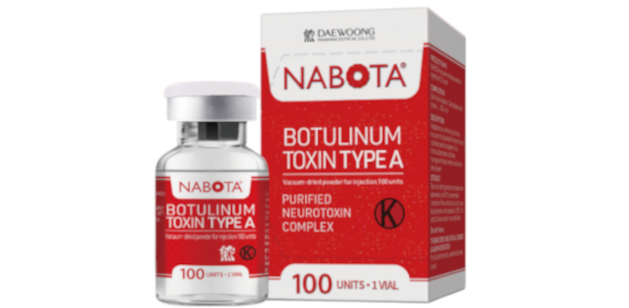
The active ingredient in Nabota is botulinum toxin type A (prabotulinumtoxinA) – a protein complex with a molecular weight of approximately 900 kDa. The preparation is characterized by very high purity (>98%) thanks to patented purification technology [5]. Each vial contains 100 units of toxin dissolved in lyophilized powder and a stabilizer – 0.5 mg of human albumin and 0.9 mg of sodium chloride [6]. Once dissolved, the Nabota solution is colorless and clear [7]. This form allows for precise dosing of the drug.
Dosages and packaging
Aesthetic applications
Nabota is mainly used to smooth facial expression lines. Its effectiveness has been confirmed in the area of the frown lines between the eyebrows, on the forehead, and around the eyes (crow’s feet) [11] [12]. In a multicenter study of patients with difficult crow’s feet, the administration of 24 U of Nabota resulted in improvement in 69.6% of patients after 4 weeks (in the placebo group – 0%) [11]. Similarly, in studies on glabellar wrinkles, over 67% of patients achieved significant improvement (two-point decrease on the GLS scale) thanks to Nabota [12]. The effect appears quickly – according to the data, the average time to onset of action is approximately 2.3 days after injection [13]. Patients usually observe a smoothing of wrinkles within 2–3 days after the procedure. The effects then last for several months, after which they clearly weaken.
Medical applications
In addition to aesthetics, Nabota has found therapeutic applications in muscle disorders. In South Korea, the product has been registered for the relief of upper limb muscle spasticity after stroke [14] and for the treatment of blepharospasm (blepharospasm) [15]. As prabotulinumtoxinA, it is also being studied in the treatment of chronic migraine and cervical dystonia. Worldwide, this toxin is used outside of aesthetic indications to treat excessive sweating and bruxism, similar to other botulinum toxins. In the United States, migraine therapy with Nabota (Jeuveau) is being researched and has shown promising results, although the drug has not yet been officially registered for this indication.
Comparison with other preparations
Nabota belongs to the same type of toxins as Botox (onabotulinumtoxinA), Dysport, and Xeomin, differing in terms of complex size and purity, among other things. Its 900 kDa molecule is larger than that of many competitors (e.g., Hutox has ~500 kDa), which limits the diffusion of the preparation into the surrounding area [5]. In clinical trials, Nabota proved to be no less effective than Botox – in phase III treatment of frown lines, the percentage of patients with improvement after 4 weeks was 93.9% for Nabota vs. 88.6% for Botox (adverse events were equally rare in both groups) [16]. Due to its higher purity and lower diffusion, Nabota is often chosen for precise treatments (e.g., between the eyebrows or around the eyes), while preparations with higher diffusion (e.g., Hutox, Neuronox) can be used for more extensive procedures (e.g., mastectomy). Above all, however, Nabota is a cost-effective alternative to Botox – it offers similar effectiveness at a usually lower price per session.
Action and duration of effect
Nabota works by temporarily blocking the release of acetylcholine at the neuromuscular junction, resulting in temporary paralysis (relaxation) of the facial muscles. The effect is rapid: improvement is observed in approximately 85% of patients as early as 2 days after injection (according to the doctor’s assessment) [13]. The full clinical response develops within 1-2 weeks and then gradually subsides. According to the instructions, the duration of action of a single dose is on average 3-4 months [10], although in practice it is usually around 3-6 months, depending on the site of administration and the individual characteristics of the patient. After this time, the nerve fibers regain their connections with the muscle and the effects subside, requiring the procedure to be repeated. Common side effects (such as headaches and temporary weakness around the eye) are short-lived and resolve spontaneously.
Clinical trials and safety
The efficacy and safety of Nabota have been confirmed in numerous studies. Multicenter clinical trials of NABOTA (prabotulinumtoxinA) included a total of over 2,100 patients [17]. Phase III and IV results confirmed that Nabota’s efficacy in reducing wrinkles is not inferior to other type A toxins, while maintaining a similar safety profile. In a controlled trial, Nabota achieved a 93.9% response rate (≥1-grade improvement) within 4 weeks, while Botox achieved 88.6% [16]. Adverse events were rare (including transient headache or facial muscle asymmetry) and mild – in one study, they were reported in approximately 9.5% of patients [18]. Immunogenicity studies have shown no formation of neutralizing antibodies after Nabota administration: for example, no new antibodies were detected in any of the 135 patients for 16 weeks after injection. In summary, recent publications evaluate Nabota as a highly effective and safe drug with a side effect profile similar to that of classic botulinum preparations [11] [18].
Expert opinions and legal regulations
Experts emphasize that Nabota meets strict quality standards (cGMP standards) and is being introduced to the global market through international partnerships (e.g., Daewoong’s collaboration with Evolus in the US). In Europe, Nabota is approved for marketing as Nuceiva™ (following a positive opinion from the EMA in 2019) and is already available in many EU countries [4] [19]. In European Union countries (including Poland), like any toxin-based drug, it is available only by prescription and can only be administered by appropriately qualified physicians. In practice, aesthetic physicians note its rapid onset of action and recommend it to patients who value a natural effect and minimal diffusion. Based on the available data, both patients and doctors are highly satisfied with the effectiveness and tolerance of this preparation.
Sources:
[1] edaegypt.gov.eg
https://edaegypt.gov.eg/media/5enh53gy/par-nabota_.pdf
[2] [3] [4] [5] [12] [14] [15] First Asian Botulinum Toxin – Nabota®
[6] [7] [8] [9] [10] cdn.medpath.com
https://cdn.medpath.com/drug/instruction/20240511/b466c88bbf6c655ccb2126a8045f6f0f.pdf
[11] Efficacy, Safety, and Subject Satisfaction of PrabotulinumtoxinA for Moderate-to-Severe Crow’s Feet: A Phase IV, Multicenter, Double-Blind, Randomized, Placebo-Controlled Trial
https://www.mdpi.com/2077-0383/12/19/6326
[13] [16] [18] Safety, efficacy, and onset of a novel botulinum toxin type A (Nabota) for the treatment of glabellar frown lines: a single-arm, prospective, phase 4 clinical study – PMC
https://pmc.ncbi.nlm.nih.gov/articles/PMC6177673
[17] Evolus Provides Update on Nuceiva™ Marketing Authorization Application in Europe | santé log
[19] Daewoong Pharmaceutical Reports Third Quarter 2023 Financial Results